


Motorhome depreciation: at what age does a used buy really pay off?
Last updated: November 25, 2026
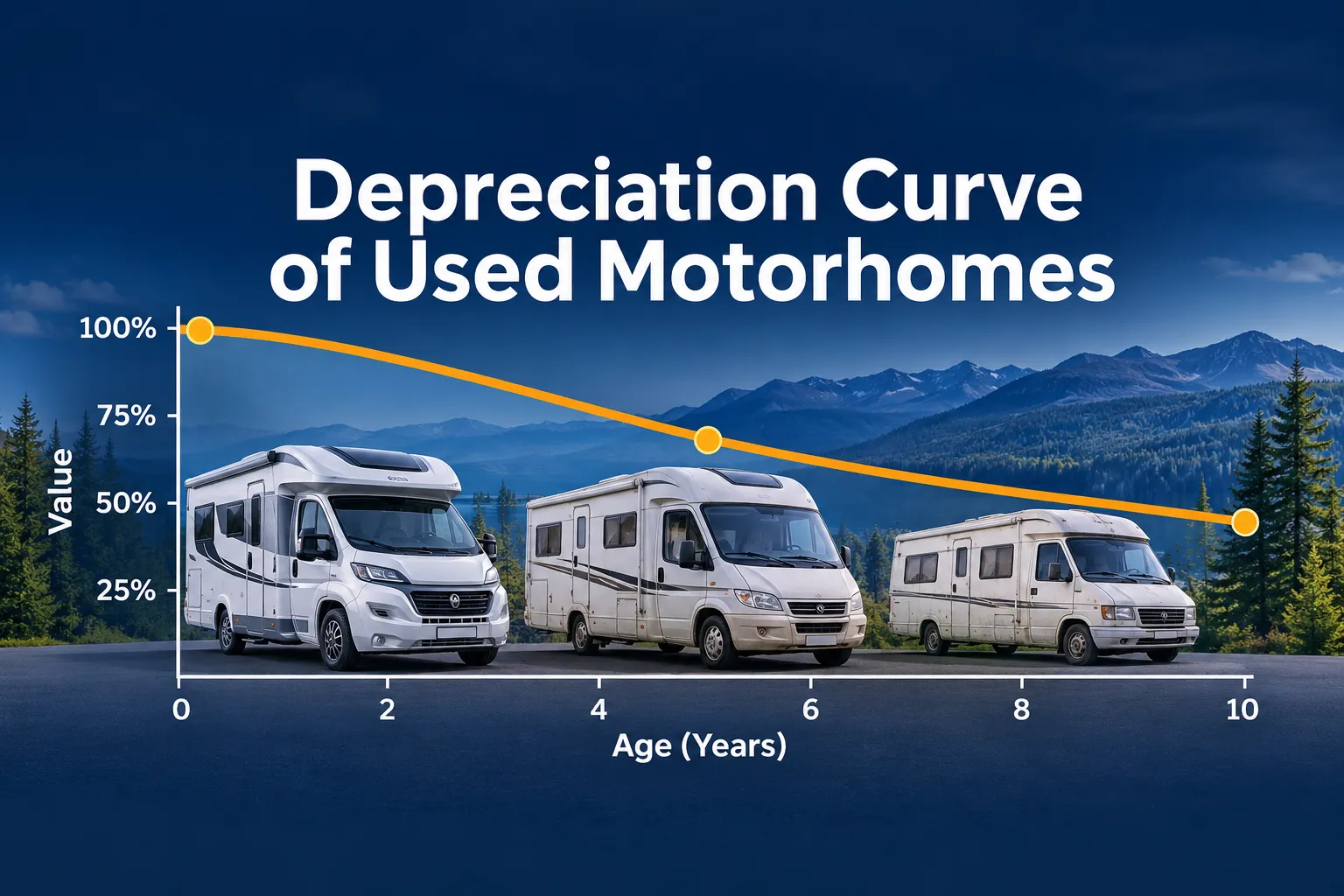
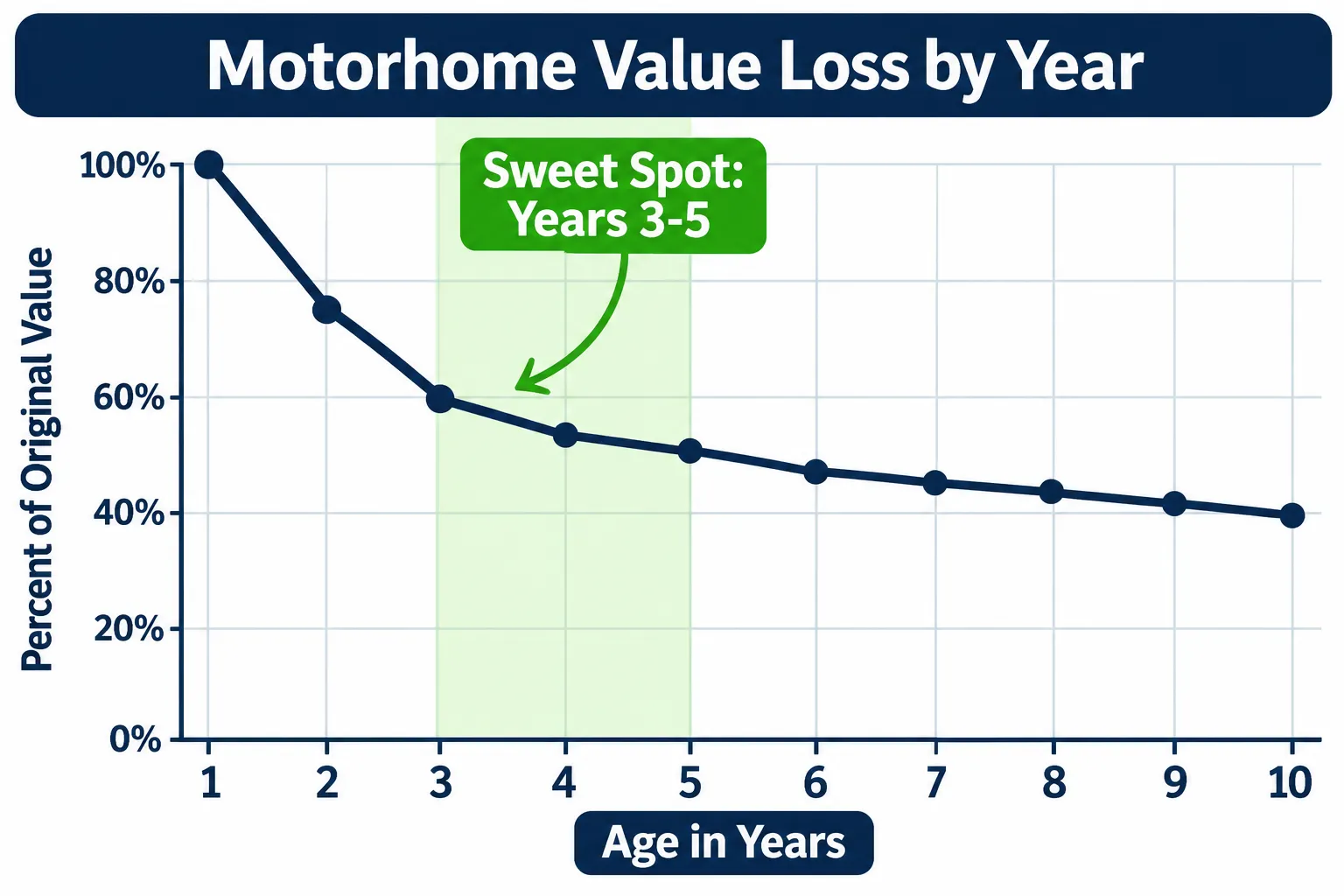
A new motorhome often loses 30 to 40 percent of its list price within the first three years. After that, the curve slows noticeably. Somewhere between year three and five lies the point where buyers get the best mix of price, substance, and resale value.
Anyone scrolling through classifieds who hesitates at a ten-year-old vehicle is right to ask: is it still worth it, or is this a money pit? The answer depends less on the calendar year and more on mileage, maintenance condition, and brand. Still, the depreciation pattern of used motorhomes follows a fairly predictable curve that can guide a smart purchase decision.
Short Answer
The best compromise between price, usable lifespan, and resale value lies with motorhomes aged three to five years. By this stage, the steepest part of the depreciation curve is already behind the vehicle, the technology is still young enough for several trouble-free years, and the purchase price typically sits 30 to 45 percent below the original new price. Vehicles over 15 years old can still be worthwhile if mileage and moisture protection are excellent, but they carry a higher repair risk.
Key Takeaways
- The biggest value loss happens in the first three years, often 30 to 40 percent from the factory price.
- Between year three and eight, the value curve flattens considerably, roughly 5 to 8 percent per year.
- The sweet spot for a used purchase is three to five years of age.
- Mileage or engine hours often matter more than the model year itself.
- Brands with strong value retention, certain Fiat Ducato and Mercedes Sprinter base vehicles, hold prices better.
- Vehicles over 15 to 20 years only make sense with a complete service record and a recent seal inspection.
- An independent moisture check before purchase prevents the most expensive hidden damage.
- Renting instead of buying can be cheaper than a bad purchase for beginners with an unclear travel pattern.
How Much Value Does a Motorhome Lose Per Year?
In the first year, a new motorhome loses an average of 15 to 20 percent of its purchase price. In years two and three, another 8 to 12 percent is lost each year. From year four onward, the curve flattens to about 5 to 8 percent annually.
This pattern is typical for vehicles with high equipment levels and fast technical aging, similar to caravans and premium cars. The reasons include the first-registration discount, outgoing model years, and the fact that buyers wanting a "like-new" vehicle often prefer buying new outright.
A practical example: a coach-built motorhome with a new price of 70,000 euros realistically sits at 42,000 to 46,000 euros after three years, around 35,000 to 38,000 euros after five years, and often still 20,000 to 24,000 euros after ten years, provided maintenance and mileage are in good shape.
| Age | Estimated Residual Value (of New Price) |
|---|---|
| 1 year | 80-85% |
| 3 years | 60-65% |
| 5 years | 50-55% |
| 8 years | 35-40% |
| 12 years | 25-30% |
| 18+ years | 10-18% |
At What Age Is a Used Motorhome No Longer Worth Buying?
A used motorhome usually stops being a good deal once it is over 18 to 20 years old and also shows high mileage, an unclear maintenance history, or visible moisture damage. Age alone is not the deciding factor.
Things get risky specifically with these combinations:
- Over 150,000 kilometers combined with a missing service record
- Visible water stains around roof hatches or window frames
- No information on the most recent inspection defects
- Construction materials that can no longer be retrofitted to current standards (such as outdated gas systems)
A 22-year-old model with 60,000 kilometers that has been serviced annually at a specialist workshop can still be a solid choice. A 14-year-old vehicle with 180,000 kilometers and three previous owners is a bigger risk. The deciding factor is the combination of age, mileage, and documentation, not the year alone.
Which Motorhomes Hold Their Value Best?
Motorhomes built on proven base vehicles, from established manufacturers, with moderate factory equipment tend to retain value best. Models based on the Fiat Ducato, Mercedes Sprinter, or Ford Transit remain especially sought after, since parts and service networks are available across Europe.
Factors supporting value stability:
- Common base vehicles with a wide service network
- Semi-integrated layouts, which tend to be more popular with resale buyers than pure coach-built models
- Established manufacturers with long model histories (such as Hymer, Dethleffs, Knaus, Bürstner)
- Factory-installed solar packages and lithium batteries, since retrofitting is expensive and rewarded at resale
- Compact lengths under 7 meters, which face fewer driving restrictions across European countries
Niche models with unusual floor plans or special equipment often lose value faster because the pool of interested buyers is smaller.
Is a 5-Year-Old Motorhome Cheaper Than a 10-Year-Old One?
Yes, a 5-year-old motorhome is almost always more expensive to buy than a 10-year-old one, but the cost per remaining year of use is often lower for the younger vehicle. That is because the older vehicle has already used up a larger share of its total service life.
A simple calculation illustrates this: if a 5-year-old model costs 38,000 euros and can realistically last another 10 years, that works out to roughly 3,800 euros per year (excluding resale value). A 10-year-old model costing 24,000 euros with 6 years of remaining use comes to 4,000 euros per year. The seemingly cheaper purchase is not automatically cheaper on a per-year basis.
Repair costs also rise with age, especially for seals, tires, and body components. These costs need to be factored in, otherwise the older vehicle looks better on paper than it performs in practice.
What Hidden Costs Arise After Buying a Motorhome?
After purchase, recurring costs appear for insurance, inspections, gas checks, tire replacement, seal renewal, and winterizing, expenses many first-time buyers underestimate. These items can add up to several thousand euros per year.
Typical recurring costs:
- Liability and partial comprehensive insurance, depending on vehicle value and driver age
- Main inspection and gas check (G607) every two years
- Seal inspection on the roof and window frames, ideally annually
- Tire replacement, since motorhome tires should be changed based on age, not just mileage
- Storage or garage rental during downtime
- Battery replacement for the leisure battery, especially older lead-gel systems
Buyers who skip planning for these costs are often in for an unpleasant surprise at the first inspection. A buffer of at least 1,500 to 2,500 euros for the first year is realistic, regardless of the vehicle's age.
How Can the Resale Value of a Motorhome Be Calculated?
Resale value can be estimated by comparing listings for the same brand, model year, and similar mileage, then applying a discount for condition and missing equipment. A professional appraisal from a certified inspector adds extra confidence.
Practical steps:
- Collect three to five comparable listings with similar model year and mileage
- Calculate the average of these asking prices
- Subtract 10 to 15 percent, since asking prices are usually higher than actual sale prices
- Assess the condition of seals, tires, and body technology separately and adjust the estimate up or down
- If uncertain, hire a TÜV or DEKRA appraiser for an official valuation
This approach gives a realistic picture of a motorhome's value development instead of relying on a seller's gut-feeling price.
What to Watch for When Buying a Used Motorhome to Avoid Being Scammed
A systematic check of moisture, documentation, and vehicle history offers the most reliable protection against fraud. Buyers who rely on first impressions often miss the most expensive defects.
Inspection checklist:
- Use a moisture meter on the roof, windows, and floor panel
- Compare the vehicle registration and service booklet against the chassis number
- Check the number of previous owners in the vehicle title
- Verify accident history through an inspection authority or independent appraiser
- Test heating, refrigerator, water pump, and leisure battery on site
- Request a security ownership transfer check if financing is suspected
A common scam involves manipulated mileage on base vehicles with poorly documented maintenance. Buyers who are unsure should make the purchase contingent on an independent inspection before any money changes hands.
Does It Make Sense to Buy a Motorhome Over 20 Years Old?
A motorhome over 20 years old can be worthwhile if it has been stored dry, maintained regularly, and driven with moderate mileage. For buyers looking for an affordable entry-level vehicle for occasional weekend trips, this is a realistic option.
Buying becomes a bad idea if replacement parts for the body are no longer produced, the interior is heavily worn, or the gas system no longer meets current inspection standards. In these cases, repair costs quickly exceed the purchase price.
Rule of thumb: only buy a motorhome over 20 years old if a current moisture report is available, the gas inspection is recent, and the seller can show a complete maintenance history. If any one of these three is missing, the risk outweighs the price advantage.
Common Mistakes When Buying a Motorhome That Ruin Resale Value
The most expensive mistakes in motorhome buying come from overlooked moisture damage, missing documentation, and unusual modifications that future buyers won't pay for. These mistakes are avoidable with some preparation.
The most frequent pitfalls:
- Buying without a moisture check, which later leads to costly roof repairs
- Missing invoices for completed maintenance, which makes resale harder
- Highly personalized modifications (such as removed seating benches) that shrink the pool of future buyers
- Neglected tire care, even on low-mileage vehicles
- Vehicles from rental fleets without a clear maintenance history
Avoiding these mistakes can noticeably improve a motorhome's resale value, often by several thousand euros at the time of sale.
How Do Mileage and Engine Hours Affect a Motorhome's Value?
Mileage and engine hours influence a motorhome's value more than age alone, because they reflect the actual wear on the engine, transmission, and chassis. A low-mileage older vehicle can therefore hold its value better than a younger high-mileage one.
Rule of thumb for assessment:
- Under 8,000 kilometers per year counts as light use, which supports value
- 8,000 to 15,000 kilometers per year is considered average
- Over 15,000 kilometers per year leads to steeper discounts, especially past 150,000 total kilometers
For vehicles with very low mileage but high age, it's worth checking how much time was spent standing still, since long periods of inactivity damage seals, tires, and brakes just as much as excessive mileage.
Is It Better to Rent a Motorhome Instead of Buying One?
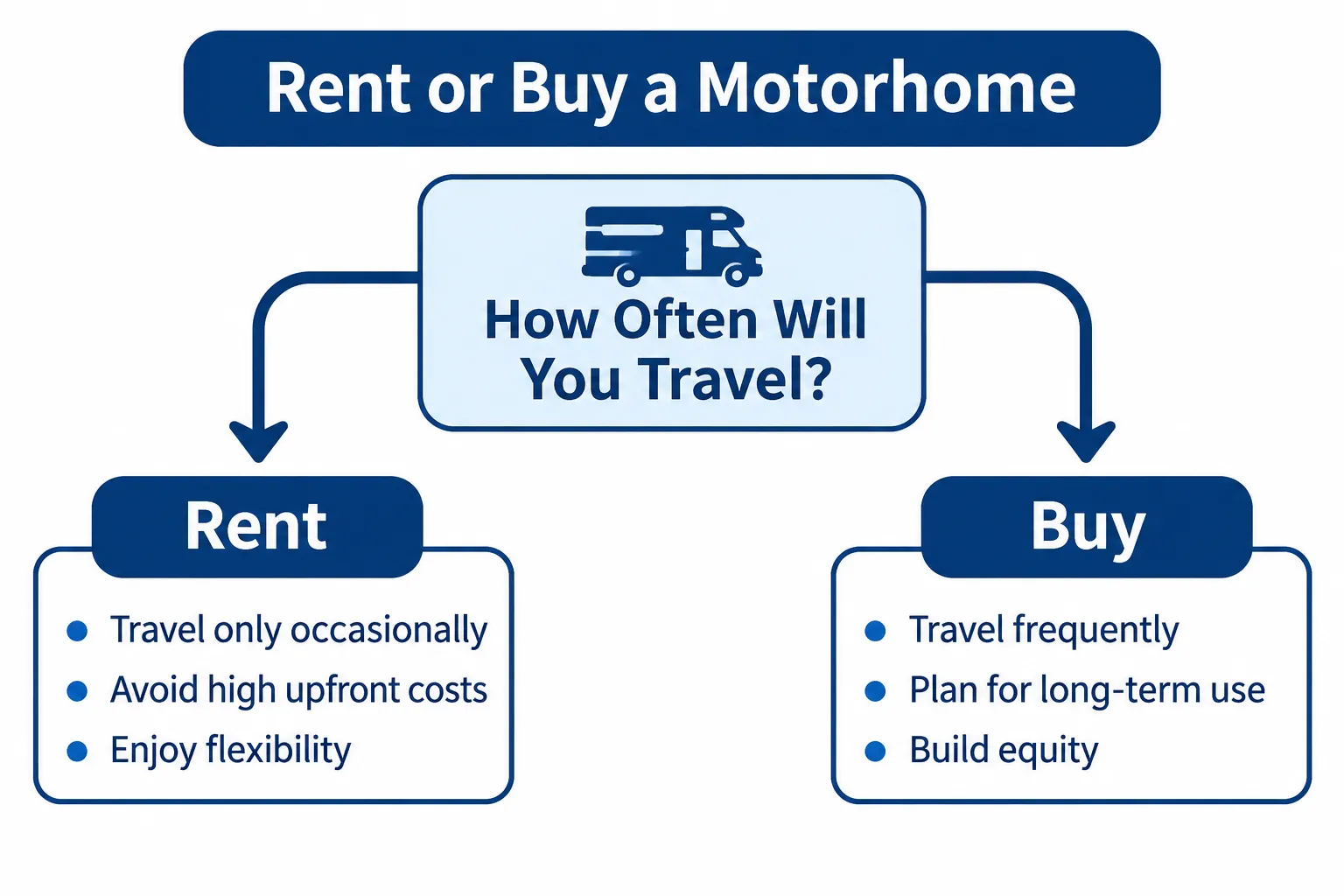
For beginners with an unclear travel pattern, renting is often the cheaper and lower-risk option before making a larger investment. Anyone traveling fewer than three to four weeks per year frequently loses money on a purchase once storage costs, depreciation, and maintenance are factored in.
Buying tends to pay off when:
- More than 6 to 8 weeks are spent traveling per year
- A dedicated parking spot or garage is available
- Long-term use over 5 years or more is planned
Renting tends to pay off when:
- Travel frequency is still uncertain
- Different layouts and vehicle types need to be tested before committing
- No dedicated storage space is available
Those unsure can combine both approaches: rent for one or two seasons to learn personal travel habits, then buy a used motorhome aged three to five years with more confidence.
When Is the Best Time to Sell a Motorhome?
The best time to sell is shortly before the next major maintenance interval (inspection, gas check) and in spring, when demand for motorhomes peaks seasonally. Selling right after a fresh main inspection often brings a noticeably higher price.
It also helps to sell before the vehicle crosses the 8-year mark rather than after, since many buyers mentally draw a line at "under 10 years old." A sale just before that threshold typically brings more than one shortly after.
Can a High-Mileage Motorhome Still Fetch a Good Price?
Yes, a high-mileage motorhome can still command a good price if it comes with a complete service record, a well-maintained interior, and a recent moisture report. Buyers often value transparency more than a low mileage figure without supporting documentation.
A vehicle with 200,000 kilometers and a full workshop history often sells more easily than one with 80,000 kilometers and no documentation at all. The decisive factor is provable upkeep, not the number alone.
Which Brands and Models Are the Safest Used Purchases?
The safest used purchases tend to come from established manufacturers such as Hymer, Dethleffs, Knaus, Bürstner, and Carthago, combined with common base vehicles like the Fiat Ducato, Mercedes Sprinter, or Ford Transit. These combinations benefit from a dense service network and solid parts availability throughout the DACH region.
Caution is warranted with small-batch builds or imported models from outside Europe, since body and interior parts can be hard to source there. Buyers who want extra security should stick to models that have been in continuous production for at least ten years.